Repair scope
Backflow preventer repair starts with the failed component—not a universal kit
Identify the assembly, exact failed area, model, size, parts support, isolation plan, retest, and report path before approving repair work.
A repair scope is credible only when the model, size, failed component, body condition, and post-repair test route are known. A kit name alone is not a diagnosis.
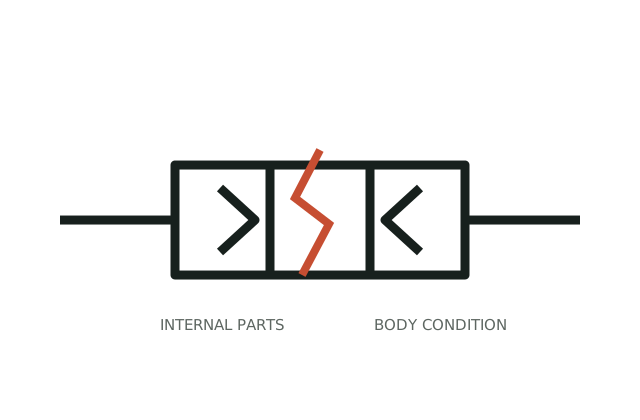
Do not open, cap, or bypass a pressurized backflow assembly without the correct isolation, manufacturer procedure, and qualified service path.
Interactive check
Turn observations into a next step
This narrows the route. It does not replace an on-site test, manufacturer instructions, or local requirements.
Evidence sequence
Move in this order
- 01
Identify before disassembly
Photograph the full model label, size, covers, relief opening, shutoffs, and test cocks.
- 02
Write a component-level scope
Ask for the failed component, official part family, labor, shutdown, and any body or piping exception.
- 03
Close the testing loop
Confirm tester eligibility, retest timing, report filing, and the record required by the governing utility.
Identification notes
What to look for
- Record the full body label, size, device type, and exact leak or failed-test observation.
- Separate check, relief, seal, cover, shutoff, and body damage; they are different repair scopes.
- Confirm whether the governing utility requires a passing retest and accepted filing after service.
Safe observations
What you can check without taking it apart
- Keep the failed-test report and model photo together.
- Ask whether the quoted part is an official or approved replacement for the exact model.
- Ask whether the scope includes retesting and filing.
- Keep relief and vent openings unobstructed.
Stop conditions
Move to qualified help when
- Cracked or distorted body
- Uncontrolled discharge or flooding
- Fire or high-hazard service
- No documented post-repair test route
Boundary check
Do not confuse this path with
- A pressure regulator repair has different pressure and expansion considerations.
- A sewer backwater valve repair is not potable-water backflow service.
- A generic online kit listing does not establish model compatibility.
Official local layer
Your utility sets the rule
Component compatibility comes from the exact manufacturer record. The governing utility controls required testing and submission after service.
Evidence ledger
What this decision path is built on
Component compatibility comes from the exact manufacturer record. The governing utility controls required testing and submission after service.
- 01U.S. EPA · EPA-CCC-001Cross-Connection Control ManualBackflow, backsiphonage, device families, hazard protection, testing, and program responsibility. Verified 2026-08-02.
- 02Watts · WATTS-RPZ-009Series 009 reduced pressure zone assemblyRPZ construction, relief discharge, installation constraints, service literature, and local-code warning. Verified 2026-08-02.
Continue the case
Related next steps
CONTENT REVIEWED · 2026-08-02