Problem path 01
Why is the backflow preventer leaking? Start with the exit point.
Use leak location, timing, weather, and recent work to choose the next safe step without pretending to diagnose a sealed assembly from a photo.
A brief release can be different from continuous discharge. The useful clues are the exact opening, whether flow stops, recent freezing or service, and visible body damage.
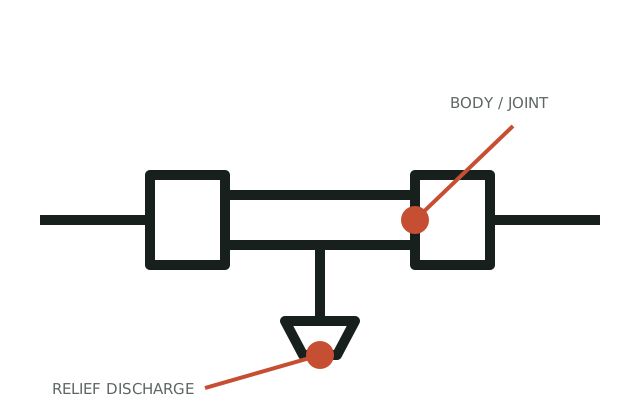
Continuous discharge, flooding, freezing, or a cracked body needs prompt professional attention. Never plug a relief or vent opening.
Interactive check
Turn observations into a next step
This narrows the route. It does not replace an on-site test, manufacturer instructions, or local requirements.
Evidence sequence
Move in this order
- 01
Mark the exit point
Take a short video that includes the full device and the exact point where water begins.
- 02
Record the timing
Note continuous, intermittent, irrigation start, shutdown, overnight, or freeze/thaw behavior.
- 03
Check the compliance consequence
Repair or replacement may need a passing retest and accepted report before the utility record closes.
Identification notes
What to look for
- Relief opening: water exits an intentional opening below the assembly.
- Body or joint: water appears at a crack, fitting, test cock, or cover.
- Downstream drain-down: a short release happens around irrigation start or shutdown.
Safe observations
What you can check without taking it apart
- Keep the relief opening unobstructed.
- Check for visible cracks and ice without touching a pressurized assembly.
- Record recent valve work, water shutoffs, irrigation changes, or freezing weather.
- If you know the correct upstream shutoff and can operate it safely, follow the property emergency procedure.
Stop conditions
Move to qualified help when
- Flow is forceful or cannot be contained
- Water can reach electrical equipment or create ice
- The body is cracked
- The device serves fire protection or a critical commercial process
Boundary check
Do not confuse this path with
- Water from a pressure-regulator bell or adjustment screw is a different problem.
- Water at a hose faucet may come from a hose-bib vacuum breaker.
- Wastewater backup is a sewer backwater problem.
Official local layer
Your utility sets the rule
Likely causes are presented as possibilities, not remote diagnoses. Manufacturer instructions and a qualified local professional control service work.
Evidence ledger
What this decision path is built on
Likely causes are presented as possibilities, not remote diagnoses. Manufacturer instructions and a qualified local professional control service work.
- 01U.S. EPA · EPA-CCC-001Cross-Connection Control ManualBackflow, backsiphonage, device families, hazard protection, testing, and program responsibility. Verified 2026-08-02.
- 02Watts · WATTS-RPZ-009Series 009 reduced pressure zone assemblyRPZ construction, relief discharge, installation constraints, service literature, and local-code warning. Verified 2026-08-02.
Continue the case
Related next steps
CONTENT REVIEWED · 2026-08-02