Problem path 02
Vacuum breaker leaking: top, vent, or hose connection?
Locate a leaking vacuum breaker and distinguish PVB startup spillage, continuous bonnet discharge, freeze cracks, and hose-bib leakage before choosing parts.
Vacuum breakers intentionally admit air, so the vent cannot be sealed. A short event during pressure change is not the same evidence as continuous flow or a cracked bonnet.
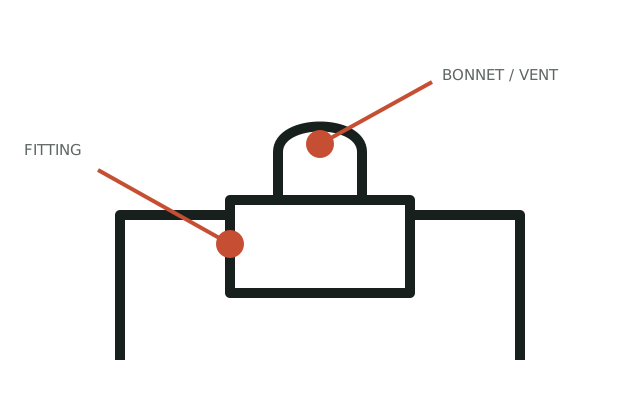
Do not cap the vent. Isolate only through a known safe procedure, especially when freezing or flooding is possible.
Interactive check
Turn observations into a next step
This narrows the route. It does not replace an on-site test, manufacturer instructions, or local requirements.
Field reference
Where and when is the vacuum breaker leaking?
Record a full start/run/stop cycle from a safe distance. The 800M4 manual describes startup spillage while its air inlet is still open; persistent flow needs a different assessment.
| Observation | What it establishes | Next step |
|---|---|---|
| PVB top / air inlet at startup | A brief event while pressure builds can differ from a leak that continues during steady operation. | Record duration and whether the release stops. Follow the exact startup instructions; do not improvise valve operation. |
| PVB bonnet continuously during flow | Timing alone cannot distinguish debris, seals, pressure conditions, or damage. | Keep the vent open and request a model-specific inspection. Continue → |
| Bonnet, body, or fitting with a visible crack | A damaged pressure boundary changes repair scope; a seal kit may not solve it. | Avoid pressurized disassembly; compare qualified replacement and retest scope. Continue → |
| Hose-end vent after shutting off the faucet | First establish that this is a hose-bib vacuum breaker, not a testable PVB. | Compare the attachment type and manufacturer instructions. Continue → |
- Manufacturer Watts 800M4 / LF800M4 manual: startup and service
- Manufacturer Watts Series 8 hose-connection vacuum breaker
Field reference
FEBCO 765: minor leakage and major discharge are different clues.
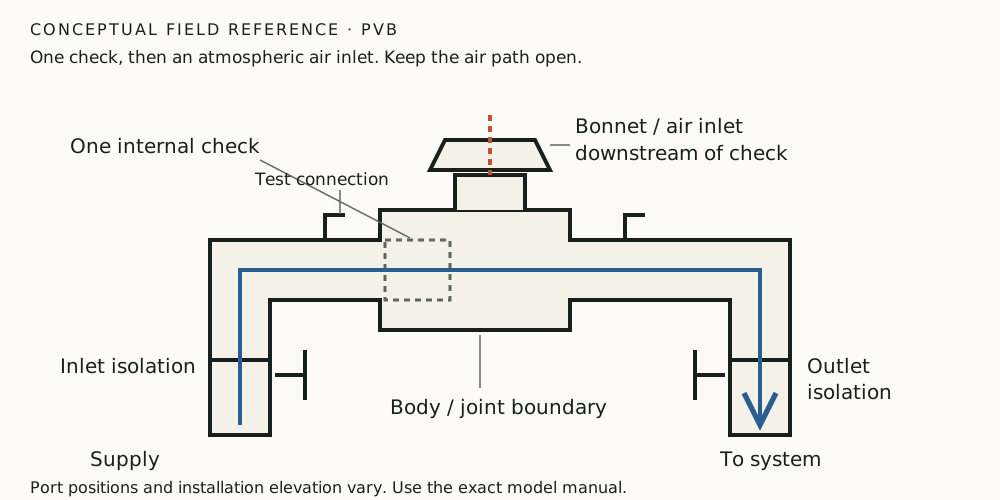
Page 6 of the FEBCO 765 manual separates the observations below. Pressure testing and disassembly belong to qualified personnel; the owner’s task is to document location, timing and device identity.
| PVB manufacturer checks | What the manual lists | Next decision |
|---|---|---|
| Minor leakage through the air vent | Possible seal damage, a damaged poppet or bonnet, or debris on the sealing surface. | Record the exact wet opening and obtain a model-specific assessment. Continue → |
| Significant air-vent discharge | Possible poppet guidance or seal failure, low downstream pressure, or inadequate inlet volume. | Ask the technician to evaluate system conditions as well as parts; do not improvise valve throttling. Continue → |
| Leaks again after a bonnet/poppet change | A changed part does not establish the cause or a passing test. FEBCO also publishes a warning about visually similar replacement parts. | Confirm exact model/size, approved part identity, and post-service test rather than ordering another guessed kit. Continue → |
| Hose-end attachment after faucet shutdown | A hose-bib vacuum breaker has a different construction and service path from a testable irrigation PVB. | Use the hose-bib guide and the attachment manufacturer’s instructions. Continue → |
- Manufacturer FEBCO 765 troubleshooting · PDF p. 6
- Manufacturer FEBCO advisory on unapproved replacement parts
Documented cases
What the published cases establish.
These are attributed manufacturer project reports or historical incidents compiled by EPA. BackflowVerdict did not perform or independently inspect this work. The takeaway is our interpretation; a case does not diagnose your assembly.
Historical incident · EPA compilation, Exhibit 5.1
Michigan, 1991: a vacuum-breaker failure
- Context
- An atmospheric vacuum breaker protected an irrigation connection to a public supply.
- What the source reports
- EPA’s 2002 review, citing AWWA PNWS, records a malfunction that allowed irrigation water into the public system.
- Takeaway and limits
- Identify the protection type and verify operation after service. This was an AVB incident, not an 800M4 or FEBCO 765 PVB repair case; the summary supplies no model-specific repair outcome.
Evidence sequence
Move in this order
- 01
Identify PVB, AVB, or hose-bib
The repair path depends on the actual device family.
- 02
Observe one complete cycle
Record before start, during flow, shutdown, and several minutes after.
- 03
Check local consequences
A testable irrigation assembly may require a test after repair or replacement.
Identification notes
What to look for
- Start-up or shutdown only: record how long the release lasts.
- Continuous from the bonnet: debris, sealing, pressure, or damage may need service.
- From a visible crack: freeze damage is more likely than a replaceable seal alone.
Common questions
Interpreting a leak.
Read these with the linked model documents. Confirm service and testing requirements with the governing authority.
Is a vacuum breaker supposed to leak when irrigation starts?
The Watts 800M4 manual describes spillage while the air inlet is still open during pressurization. Record whether it ends once steady operation begins. Continuous discharge, damage or recurring unusual behavior needs assessment; no fixed “normal duration” applies to every model.
Why is my FEBCO 765 leaking from the top?
The 765 manual lists several different conditions for minor air-vent leakage and significant discharge. Parts damage, debris and system pressure/volume can require different work. The top location alone does not confirm that a bonnet kit is the remedy.
Why does it still leak after replacing the bonnet and poppet?
Have the repairer verify parts identity, fit, sealing surfaces and operating conditions against the exact manual, then test after service. The symptom can persist when the original cause was not the replaced component.
Are a hose-bib vacuum breaker and a PVB repaired the same way?
They are different devices. Identify the attachment or testable assembly by its label and construction. Do not transfer an irrigation PVB repair procedure to a hose-end device.
Does a freeze sensor or freeze-resistant label eliminate winterization?
Use the exact model’s freeze instructions. An alert sensor reports conditions and needs the required connection/activation; it does not itself prevent freezing. Freeze protection and seasonal service remain model- and site-specific.
Safe observations
What you can check without taking it apart
- Remove no covers while pressurized.
- Look for freeze cracks and loose external fittings.
- Record the make, model, pipe size, and installation height.
- Keep the air inlet open.
Stop conditions
Move to qualified help when
- Continuous flow
- Visible cracking
- Freezing spray
- Unknown shutoff or a commercial system
Boundary check
Do not confuse this path with
- An RPZ relief valve is below a larger inline body.
- A pressure regulator does not use an atmospheric air inlet.
- A sewer valve does not discharge clean supply water.
Official local layer
Your utility sets the rule
The page owns the observable leak decision. It does not duplicate model-specific repair instructions or invent a local testing rule.
Evidence ledger
What this decision path is built on
The page owns the observable leak decision. It does not duplicate model-specific repair instructions or invent a local testing rule.
- 01U.S. EPA · EPA-CCC-001Cross-Connection Control ManualBackflow, backsiphonage, device families, hazard protection, testing, and program responsibility. Verified 2026-08-02.
- 02Watts · WATTS-PVB-800M4Series 800M4 pressure vacuum breaker manualPVB installation, periodic testing, freeze protection, and service limitations. Verified 2026-08-02.
- 03Watts · WATTS-AVB-288ASeries 288A atmospheric vacuum breakerAtmospheric vent operation and non-continuous-pressure application limits. Verified 2026-08-02.
- 04Watts · WATTS-HOSE-008Series 8 hose connection vacuum breakerHose-thread device identification, backsiphonage protection, and service literature. Verified 2026-08-02.
- 05Watts · RECOVERY-800M4-20261012800M4 / LF800M4 installation, maintenance and repair manualPVB installation example, startup spillage and qualified service. Verified 2026-10-12.
- 06FEBCO / Watts · LEAK-765-20261012765 parts and troubleshooting manualEnglish PDF pages 5–6: separate parts, minor leakage and significant discharge. Verified 2026-10-12.
- 07EPA · LEAK-EPA-HISTORY-20261012Historical cross-connection incidents, Exhibit 5.12002 compilation citing other reports: 1991 Michigan AVB and 1995 California double-check cases; historical context, no current model diagnosis. Verified 2026-10-12.
- 08FEBCO / Watts · LEAK-765-PARTS-20261012Advisory on unapproved FEBCO replacement partsManufacturer warning: physical resemblance or threaded fit alone does not establish authorized replacement scope. Verified 2026-10-12.
Continue the case
Related next steps
CONTENT REVIEWED · 2026-10-12