Device passport 01
Backflow preventer identification: RPZ, DCVA, PVB, and look-alikes
Identify a backflow preventer from its label, relief or air opening, and system use; then separate RPZ, DCVA, PVB, and look-alike devices.
A backflow preventer protects a water supply from reverse flow, but different assemblies fail, drain, and require testing in different ways.
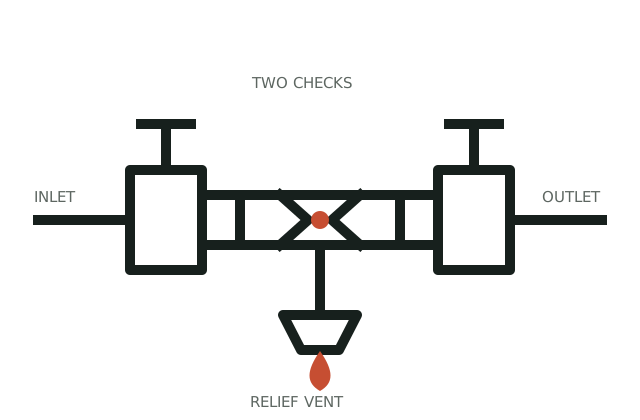
Do not open a sealed assembly or bypass it. If water is continuous, forceful, freezing, or flooding the area, move to the leak safety path.
Interactive check
Turn observations into a next step
This narrows the route. It does not replace an on-site test, manufacturer instructions, or local requirements.
Evidence sequence
Move in this order
- 01
Read the nameplate
Record the manufacturer, model, size, and any RP, RPZ, PVB, DC, or AVB marking.
- 02
Locate the air or relief opening
The location of an intentional opening is a stronger clue than the overall brass shape.
- 03
Note the system
Irrigation, fire line, domestic water, hose connection, and sewer piping do not use interchangeable devices.
Identification notes
What to look for
- A relief opening beneath the body usually points to an RP or RPZ assembly.
- A raised bonnet or air inlet above the piping often points to a pressure vacuum breaker.
- Two check modules without an open relief vent may point to a double-check assembly.
RPZ boundary
Is an RPZ different from a backflow preventer?
An RPZ is one type of testable backflow preventer. “Backflow preventer” is the broader category; RPZ, DCVA, PVB, AVB, and hose-bib devices are not interchangeable.
Safe observations
What you can check without taking it apart
- Photograph the whole assembly and the nameplate.
- Note exactly where water appears without removing covers.
- Keep the utility notice or prior test report beside the device.
Stop conditions
Move to qualified help when
- Continuous discharge that can flood or freeze
- A cracked or visibly distorted body
- A fire-protection or commercial life-safety connection
- Any instruction that would require bypassing the assembly
Boundary check
Do not confuse this path with
- A bell-shaped pressure regulator controls downstream pressure; it is not a backflow preventer.
- A sewer backwater valve blocks wastewater reversal and belongs to a separate system.
- A hose-bib vacuum breaker is a small atmospheric device at a faucet, not a testable RPZ assembly.
Official local layer
Your utility sets the rule
Identification guidance is national and observational. Testing, repair authorization, and reporting requirements must be verified with the governing utility.
Evidence ledger
What this decision path is built on
Identification guidance is national and observational. Testing, repair authorization, and reporting requirements must be verified with the governing utility.
- 01U.S. EPA · EPA-CCC-001Cross-Connection Control ManualBackflow, backsiphonage, device families, hazard protection, testing, and program responsibility. Verified 2026-08-02.
- 02Watts · WATTS-RPZ-009Series 009 reduced pressure zone assemblyRPZ construction, relief discharge, installation constraints, service literature, and local-code warning. Verified 2026-08-02.
- 03USC Foundation for Cross-Connection Control and Hydraulic Research · USC-APPROVAL-LIST-2026List of Approved Backflow Prevention AssembliesCurrent approval-list guidance: exact assembly type, manufacturer, model, size, manual edition, orientation, and approved replacement shutoff compatibility must be verified. Verified 2026-08-02.
- 04USC Foundation for Cross-Connection Control and Hydraulic Research · USC-DEVICE-GUIDE-2026Cross-connection control introduction and assembly descriptionsAssembly descriptions and the requirement to check the local administrative authority for acceptable use; supports device-family comparison and fire-system distinction. Verified 2026-08-02.
Continue the case
Related next steps
CONTENT REVIEWED · 2026-08-11