Installation decision
Backflow preventer installation requirements and detail checklist
Check backflow preventer installation requirements for assembly selection, placement, drainage, access, permits, initial testing, and utility report closeout.
A complete installation is defined by the required protection level, approved assembly, field placement details, qualified work, initial test, and accepted utility closeout—not pipe size alone.
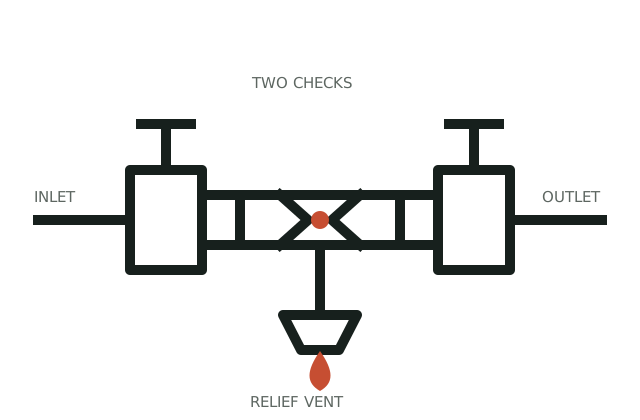
Never bypass an existing assembly or place an RPZ where relief discharge can flood, damage equipment, or create an unsafe condition. Fire and commercial systems need qualified design review.
Choose the closest evidence
What system is the installation protecting?
These are routing choices, not remote diagnoses.
Evidence sequence
Move in this order
- 01
Confirm the governing rule
Use the property utility, not a generic city assumption, to confirm the hazard category, accepted assembly type, tester requirements, and submission route.
- 02
Scope the physical installation
Document size, direction, access, freeze exposure, drainage, clearances, shutdown coordination, and whether permits or fire review apply.
- 03
Make quotes comparable
Require separate scope for the approved assembly, fittings, labor, drainage or enclosure, permit work, initial test, and report filing.
- 04
Close the compliance loop
Keep the passing test record and submission confirmation. Installation is not complete merely because water is flowing.
Identification notes
What to look for
- Record the service type: irrigation, domestic, fire, process, or combined.
- Photograph the existing pipe, meter direction, drainage, clearance, and model plate.
- Ask the governing utility which assembly type and approval list apply before purchase.
Requirement ownership
Backflow preventer installation requirements.
There is no single national device-and-placement answer. Use this checklist to identify the decisions that the governing utility, adopted code, manufacturer instructions, and qualified installer must close.
- Protection level: confirm the hazard classification and the accepted assembly family before selecting equipment.
- Approved assembly: verify model, size, orientation, and any local approved-device list or plan-review requirement.
- Placement: document access, elevation, drainage, freeze exposure, clearances, discharge route, and meter direction.
- Qualified work: confirm installer, tester, permit, fire-authority, and shutdown responsibilities before scheduling.
- Closeout: include the initial certified test, report submission, correction cycle, and acceptance proof.
Field detail
Installation detail checklist.
- Property and water account tied to the governing utility
- Protected system: irrigation, domestic, fire, process, or combined
- Existing and proposed manufacturer, model, size, flow direction, and orientation
- Upstream and downstream isolation plus service-interruption plan
- Relief discharge, drain capacity, enclosure, heat, and freeze protection
- Test access, maintenance clearance, permit, initial test, and report owner
Device comparison
Choose from the required protection, not the price.
Safe observations
What you can check without taking it apart
- Read the utility notice and meter account name.
- Photograph the site without opening or disassembling the assembly.
- Confirm pipe size and flow arrow from accessible labels.
- Ask whether the quote includes the initial certified test and report submission.
Stop conditions
Move to qualified help when
- The required assembly type is still unknown
- The proposed location lacks safe RPZ relief drainage
- A fire or life-safety system shutdown is involved
- The installer proposes bypassing testing, permits, or the utility approval path
Boundary check
Do not confuse this path with
- A sewer backwater valve protects a drain line, not the potable supply.
- A water-pressure regulator controls pressure and is not a substitute for backflow protection.
- A hose-bib vacuum breaker does not replace a testable premise assembly when one is required.
Official local layer
Your utility sets the rule
This page scopes decisions and quote line items; it does not prescribe a universal assembly. The governing utility, adopted code, manufacturer instructions, and qualified installer control the final design.
Evidence ledger
What this decision path is built on
This page scopes decisions and quote line items; it does not prescribe a universal assembly. The governing utility, adopted code, manufacturer instructions, and qualified installer control the final design.
- 01U.S. EPA · EPA-CCC-001Cross-Connection Control ManualBackflow, backsiphonage, device families, hazard protection, testing, and program responsibility. Verified 2026-08-02.
- 02Watts · WATTS-RPZ-009Series 009 reduced pressure zone assemblyRPZ construction, relief discharge, installation constraints, service literature, and local-code warning. Verified 2026-08-02.
- 03USC Foundation for Cross-Connection Control and Hydraulic Research · USC-APPROVAL-LIST-2026List of Approved Backflow Prevention AssembliesCurrent approval-list guidance: exact assembly type, manufacturer, model, size, manual edition, orientation, and approved replacement shutoff compatibility must be verified. Verified 2026-08-02.
Continue the case
Related next steps
CONTENT REVIEWED · 2026-08-11