Device passport 07
An RPZ backflow preventer uses two checks and a relief zone you must not obstruct
Identify the reduced pressure zone assembly, understand relief discharge, testing, hazard use, drainage, and the repair-versus-replacement path.
An RPZ is a testable assembly that protects against backsiphonage and backpressure for applicable hazards. Its relief valve is a safety function and can discharge when pressure relationships or internal components are wrong.
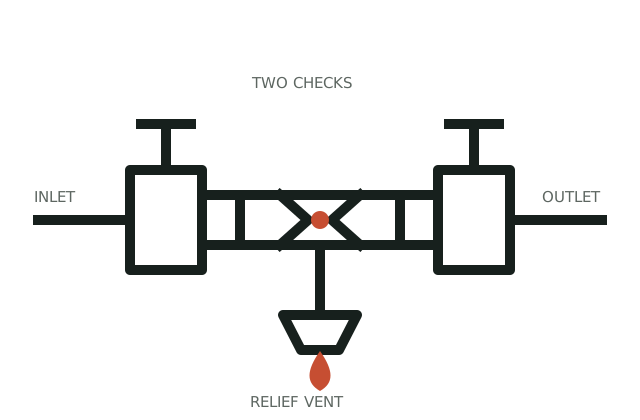
Never plug the relief opening. Indoor installations need drainage sized for potential discharge according to the model and local requirements.
Interactive check
Turn observations into a next step
This narrows the route. It does not replace an on-site test, manufacturer instructions, or local requirements.
Evidence sequence
Move in this order
- 01
Identify the full assembly
Record manufacturer, model, size, orientation, and approval label.
- 02
Protect the relief path
Keep drainage and air space unobstructed.
- 03
Use the local test workflow
Eligibility, frequency, repair, retest, and submission come from the utility.
Identification notes
What to look for
- Two checks surround a lower-pressure zone.
- A relief valve opens from the zone to atmosphere.
- Shutoffs and test cocks allow field testing.
Safe observations
What you can check without taking it apart
- Photograph the relief opening and drain.
- Record recent pressure events.
- Keep the test report and notice.
Stop conditions
Move to qualified help when
- Continuous discharge
- No drainage capacity
- Cracked body
- Fire or high-hazard commercial service
Boundary check
Do not confuse this path with
- A PVB protects only against applicable backsiphonage conditions.
- A DCVA has no relief zone.
- A regulator controls pressure rather than cross-connection risk.
Official local layer
Your utility sets the rule
The exact listing, manufacturer manual, hazard classification, and local authority determine RPZ application and testing.
Evidence ledger
What this decision path is built on
The exact listing, manufacturer manual, hazard classification, and local authority determine RPZ application and testing.
- 01U.S. EPA · EPA-CCC-001Cross-Connection Control ManualBackflow, backsiphonage, device families, hazard protection, testing, and program responsibility. Verified 2026-08-02.
- 02Watts · WATTS-RPZ-009Series 009 reduced pressure zone assemblyRPZ construction, relief discharge, installation constraints, service literature, and local-code warning. Verified 2026-08-02.
Continue the case
Related next steps
CONTENT REVIEWED · 2026-08-02