Device passport 02
Identify the vacuum breaker by where air can enter
Separate hose-bib, atmospheric, and pressure vacuum breakers before treating a drip or discharge as a failure.
Vacuum breakers stop backsiphonage by admitting air. A hose faucet attachment, an atmospheric breaker, and a testable pressure vacuum breaker are different products with different limits.
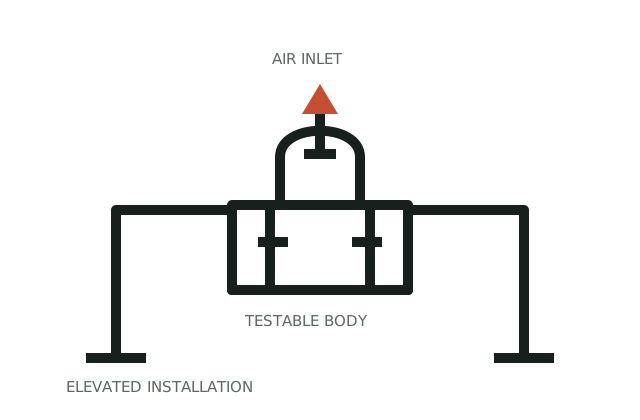
Do not cap an air inlet or relief opening to stop a leak. That opening is part of the safety function.
Interactive check
Turn observations into a next step
This narrows the route. It does not replace an on-site test, manufacturer instructions, or local requirements.
Evidence sequence
Move in this order
- 01
Find the air inlet
Look for a bonnet, poppet, or vent designed to admit air.
- 02
Check the installation height
PVBs are commonly elevated; hose-bib devices are attached directly to a faucet.
- 03
Record the model
The manufacturer model tells you whether the unit is testable and which service information applies.
Identification notes
What to look for
- A PVB normally sits above downstream irrigation piping with shutoffs and test cocks.
- An AVB is simpler and must not be treated like a continuously pressurized testable assembly.
- A hose-bib breaker threads directly onto an outdoor faucet and is much smaller.
Safe observations
What you can check without taking it apart
- Turn off the downstream irrigation zone and observe whether discharge stops.
- Look for freeze cracks without disassembly.
- Check whether debris is visible around an exposed vent.
Stop conditions
Move to qualified help when
- A cracked bonnet or body
- Continuous uncontrolled flow
- Freezing conditions around active discharge
- A device serving a commercial or fire-related system
Boundary check
Do not confuse this path with
- An RPZ has a relief zone beneath a larger inline body.
- A pressure regulator changes pressure but does not provide the same cross-connection protection.
- A sewer backwater valve is installed in drainage piping.
Official local layer
Your utility sets the rule
The shape is a screening clue, not a certification. Use the model label and the local utility rule for the final decision.
Evidence ledger
What this decision path is built on
The shape is a screening clue, not a certification. Use the model label and the local utility rule for the final decision.
- 01U.S. EPA · EPA-CCC-001Cross-Connection Control ManualBackflow, backsiphonage, device families, hazard protection, testing, and program responsibility. Verified 2026-08-02.
- 02Watts · WATTS-PVB-800M4Series 800M4 pressure vacuum breaker manualPVB installation, periodic testing, freeze protection, and service limitations. Verified 2026-08-02.
- 03Watts · WATTS-AVB-288ASeries 288A atmospheric vacuum breakerAtmospheric vent operation and non-continuous-pressure application limits. Verified 2026-08-02.
- 04Watts · WATTS-HOSE-008Series 8 hose connection vacuum breakerHose-thread device identification, backsiphonage protection, and service literature. Verified 2026-08-02.
Continue the case
Related next steps
CONTENT REVIEWED · 2026-08-02