Device passport 06
An atmospheric vacuum breaker is simple—and limited to the right pressure pattern
Identify an AVB, understand its atmospheric vent, and separate non-continuous use from PVB and hose-connection devices.
An AVB prevents backsiphonage by opening to atmosphere. It is generally selected for non-continuous pressure and is not a substitute for a testable PVB where backpressure or continuous pressure exists.
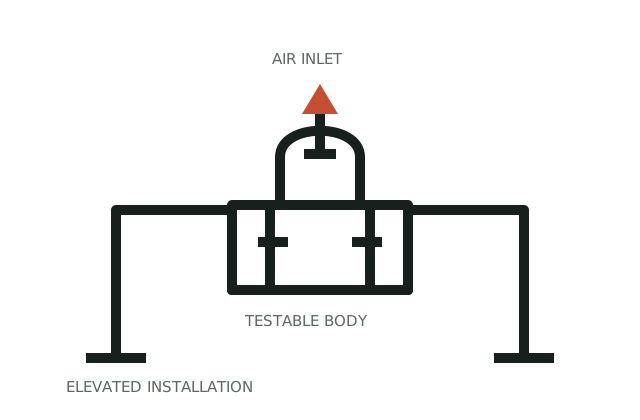
Do not place a downstream shutoff where it leaves an AVB continuously pressurized unless the exact approved design and local rule allow it.
Interactive check
Turn observations into a next step
This narrows the route. It does not replace an on-site test, manufacturer instructions, or local requirements.
Evidence sequence
Move in this order
- 01
Trace the downstream valve
Determine whether anything can hold the device under pressure.
- 02
Confirm elevation and orientation
Use the product critical-level marking and local requirement.
- 03
Match the hazard and pressure condition
Choose the protection method required by the authority having jurisdiction.
Identification notes
What to look for
- No field test cocks on a basic AVB.
- An atmospheric opening admits air when supply pressure falls.
- Placement and downstream valves determine whether it is used correctly.
Safe observations
What you can check without taking it apart
- Photograph upstream and downstream piping.
- Keep the vent open.
- Record the manufacturer and model.
Stop conditions
Move to qualified help when
- Continuous pressure on an unknown AVB
- Active uncontrolled leak
- Backpressure is possible
- Installation serves a regulated high-hazard connection
Boundary check
Do not confuse this path with
- A PVB is testable and designed for a different pressure condition.
- A hose-bib breaker attaches to faucet threads.
- An RPZ protects against both backpressure and backsiphonage when correctly applied.
Official local layer
Your utility sets the rule
Device listing, manufacturer instructions, and the local authority control continuous-pressure and installation limits.
Evidence ledger
What this decision path is built on
Device listing, manufacturer instructions, and the local authority control continuous-pressure and installation limits.
- 01U.S. EPA · EPA-CCC-001Cross-Connection Control ManualBackflow, backsiphonage, device families, hazard protection, testing, and program responsibility. Verified 2026-08-02.
- 02Watts · WATTS-AVB-288ASeries 288A atmospheric vacuum breakerAtmospheric vent operation and non-continuous-pressure application limits. Verified 2026-08-02.
Continue the case
Related next steps
CONTENT REVIEWED · 2026-08-02