Fire protection coordination
Fire sprinkler backflow installation: coordinate the protection system, not just the device
A planning page for facilities teams who need to scope fire-line backflow work while protecting system availability, inspections, permits, and authority approval.
Fire-line backflow installation is a coordinated fire-protection project, not domestic-water plumbing work. Authority requirements, impairment procedures, contractor qualifications, acceptance testing, and return-to-service all belong in the approved sequence.
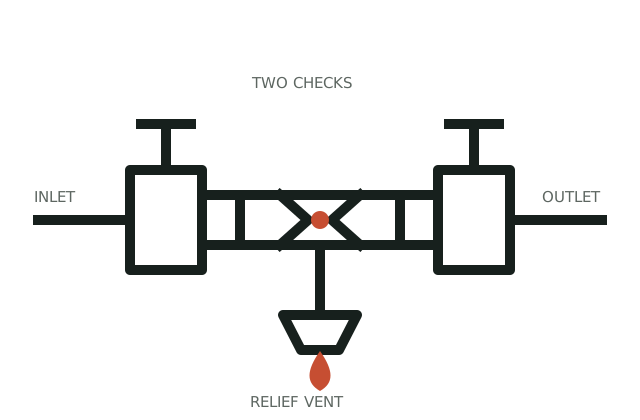
Do not isolate or alter a fire system from a generic quote. Escalate to the property fire procedure and authority before work begins.
Interactive check
Turn observations into a next step
This narrows the route. It does not replace an on-site test, manufacturer instructions, or local requirements.
Evidence sequence
Move in this order
- 01
Establish the governing record
Identify owner, fire contractor, water supplier, and authority requirements.
- 02
Define the complete work
Document impairment, notification, temporary protection, and work-window procedures.
- 03
Document completion
Confirm inspection, acceptance record, and return-to-service ownership before field work.
Identification notes
What to look for
- Fire system ownership and the authority having jurisdiction must be identified.
- Impairment notification and return-to-service procedures are separate from device installation.
- Domestic-water assumptions do not automatically apply to fire-line assemblies.
Safe observations
What you can check without taking it apart
- Use the exact property and assembly record before authorizing work.
- Confirm official program and manufacturer information for the decision.
- Keep the final result and submission evidence together.
Stop conditions
Move to qualified help when
- An approved impairment and return-to-service process is absent.
- The project assumes a domestic assembly workflow applies to a fire line.
Boundary check
Do not confuse this path with
- A generic online part or device listing does not establish the correct field scope.
- A different water-system use can require a different approval and service workflow.
- This planning page does not replace a qualified on-site assessment.
Official local layer
Your utility sets the rule
This path is governed by the official utility or authority requirement, then by exact manufacturer documentation for the identified assembly.
Evidence ledger
What this decision path is built on
This path is governed by the official utility or authority requirement, then by exact manufacturer documentation for the identified assembly.
- 01U.S. EPA · EPA-CCC-001Cross-Connection Control ManualBackflow, backsiphonage, device families, hazard protection, testing, and program responsibility. Verified 2026-08-02.
- 02Watts · WATTS-RPZ-009Series 009 reduced pressure zone assemblyRPZ construction, relief discharge, installation constraints, service literature, and local-code warning. Verified 2026-08-02.
- 03USC Foundation for Cross-Connection Control and Hydraulic Research · USC-APPROVAL-LIST-2026List of Approved Backflow Prevention AssembliesCurrent approval-list guidance: exact assembly type, manufacturer, model, size, manual edition, orientation, and approved replacement shutoff compatibility must be verified. Verified 2026-08-02.
- 04USC Foundation for Cross-Connection Control and Hydraulic Research · USC-DEVICE-GUIDE-2026Cross-connection control introduction and assembly descriptionsAssembly descriptions and the requirement to check the local administrative authority for acceptable use; supports device-family comparison and fire-system distinction. Verified 2026-08-02.
Continue the case
Related next steps
CONTENT REVIEWED · 2026-08-02