Device basics
How a backflow preventer works: understand the protection path first
Backflow prevention protects a water supply from reverse-flow conditions through a specific assembly design.
Backflow prevention protects a water supply from reverse-flow conditions through a specific assembly design. Understanding the concept helps explain testing and service, but it does not determine the required device type, installation, or repair part for a property.
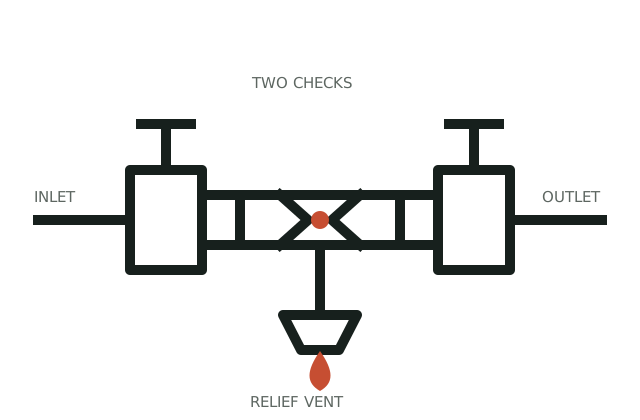
Use the governing utility or authority and exact model record for the actual requirement. Escalate active leaks, failed tests, and replacement decisions to the correct service path.
Interactive check
Turn observations into a next step
This narrows the route. It does not replace an on-site test, manufacturer instructions, or local requirements.
Evidence sequence
Move in this order
- 01
Observe and identify
Identify the actual assembly and protected connection.
- 02
Match the verified path
Read the official utility requirement and manufacturer documentation for that device.
- 03
Close the risk loop
Use the required testing and reporting process to maintain the record.
Identification notes
What to look for
- Protection devices use different mechanisms; a generic explanation does not make them interchangeable.
- Testing verifies the installed assembly rather than a general backflow concept.
- The property connection and degree of hazard drive program requirements.
Safe observations
What you can check without taking it apart
- Do not substitute a device family based on a general explainer.
- Do not assume a check valve is a complete backflow assembly.
- Keep utility notices and test reports with the asset record.
Stop conditions
Move to qualified help when
- The actual device type or requirement is unknown.
- The page is being used to approve installation or repair.
Boundary check
Do not confuse this path with
- A product-family name alone does not establish component compatibility.
- A generic online part listing is not a repair diagnosis.
- This page does not replace a qualified on-site assessment.
Official local layer
Your utility sets the rule
Use exact manufacturer literature and the governing utility or authority record to validate the device, service path, and compliance closeout.
Evidence ledger
What this decision path is built on
Use exact manufacturer literature and the governing utility or authority record to validate the device, service path, and compliance closeout.
- 01U.S. EPA · EPA-CCC-001Cross-Connection Control ManualBackflow, backsiphonage, device families, hazard protection, testing, and program responsibility. Verified 2026-08-02.
- 02Watts · WATTS-RPZ-009Series 009 reduced pressure zone assemblyRPZ construction, relief discharge, installation constraints, service literature, and local-code warning. Verified 2026-08-02.
- 03USC Foundation for Cross-Connection Control and Hydraulic Research · USC-DEVICE-GUIDE-2026Cross-connection control introduction and assembly descriptionsAssembly descriptions and the requirement to check the local administrative authority for acceptable use; supports device-family comparison and fire-system distinction. Verified 2026-08-02.
Continue the case
Related next steps
CONTENT REVIEWED · 2026-08-02