PVB repair scope
PVB repair: check the model, freeze exposure, and retest path
PVB repair must account for the exact model, vacuum-breaker configuration, above-ground installation conditions, and freeze exposure.
PVB repair must account for the exact model, vacuum-breaker configuration, above-ground installation conditions, and freeze exposure. A repair is not complete when the device is reassembled; required retesting and filing still govern closure.
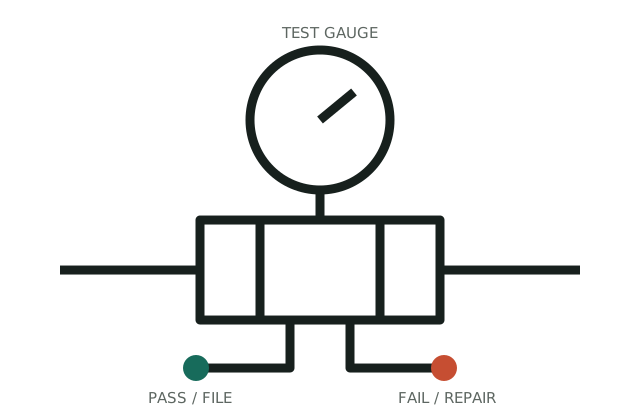
Escalate freezing damage, damaged piping, inaccessible elevation, or uncertainty about the installed PVB model and orientation.
Interactive check
Turn observations into a next step
This narrows the route. It does not replace an on-site test, manufacturer instructions, or local requirements.
Evidence sequence
Move in this order
- 01
Establish the exact record
Capture model, size, orientation, elevation context, and the visible damage or failed result.
- 02
Define the specific scope
Ask whether the body, piping, shutoffs, or supports change the repair scope beyond internal components.
- 03
Prove the closeout
Complete required certified testing and preserve the final record with irrigation asset notes.
Identification notes
What to look for
- Photograph the bonnet, label, test cocks, shutoffs, and surrounding irrigation piping.
- Check for freeze exposure and visible cracks before assuming an internal service kit is sufficient.
- Confirm whether the utility requires a certified retest after service.
Safe observations
What you can check without taking it apart
- Do not operate or service a frozen assembly until qualified assessment.
- Keep test access and air openings clear.
- Use exact model literature for internal parts.
Stop conditions
Move to qualified help when
- The body or connected piping is cracked.
- The required model or retest route cannot be verified.
Boundary check
Do not confuse this path with
- A generic service listing does not establish program eligibility.
- A device family is not enough to identify compatible parts.
- This page does not replace a qualified assessment or authority approval.
Official local layer
Your utility sets the rule
Use the governing utility or authority requirement and exact manufacturer documentation to validate this specific decision path.
Evidence ledger
What this decision path is built on
Use the governing utility or authority requirement and exact manufacturer documentation to validate this specific decision path.
- 01U.S. EPA · EPA-CCC-001Cross-Connection Control ManualBackflow, backsiphonage, device families, hazard protection, testing, and program responsibility. Verified 2026-08-02.
- 02Watts · WATTS-RPZ-009Series 009 reduced pressure zone assemblyRPZ construction, relief discharge, installation constraints, service literature, and local-code warning. Verified 2026-08-02.
- 03USC Foundation for Cross-Connection Control and Hydraulic Research · USC-APPROVAL-LIST-2026List of Approved Backflow Prevention AssembliesCurrent approval-list guidance: exact assembly type, manufacturer, model, size, manual edition, orientation, and approved replacement shutoff compatibility must be verified. Verified 2026-08-02.
Continue the case
Related next steps
CONTENT REVIEWED · 2026-08-02